Walk into the front office of a typical mid-sized school on the Friday before term end. Six windows are open on the computer: the fees portal, the attendance app, the marks spreadsheet, the SMS account, the parent WhatsApp group and an old library program nobody has the password for. The office assistant is trying to make all six agree.
None of these tools is broken on its own. The fees portal collects fees. The attendance app records attendance. The SMS account sends messages. The problem is that none of them holds the student. There are six versions of every student, kept roughly in step by tired staff.
Staff hold it all together
- Fees portal · attendance app · marks spreadsheet · WhatsApp · SMS · old library program
- Every report disagrees with the others
- Many staff hours each term spent matching figures
- New admissions appear in different tools on different days
One record holds it together
- One record for each student, used by every department
- Reports agree, because they use the same figures
- Admit once, and the parent app, fees, transport and report card are ready
- A record of every change, without extra effort
What "six tools" really costs
The cost shows up in three places, and none of them is on the invoice:
- Hours spent matching figures. Every term end, someone pulls data out of all six tools and puts it together in Excel. That can take days of staff time before anyone has answered a single parent's question.
- Reports that do not match. The fees portal says 412 students have paid. The accounts say 408. The principal's summary says 419. Each is correct for a different moment and a different list. People stop trusting any of them.
- The new admission who goes missing. A student is admitted on Monday. By Wednesday they are in the fees portal but not the parent app. By Friday they are in the parent app but not on the bus list. Nobody has the complete picture until someone notices the gap.
The hidden cost of six tools is not that any one of them is bad. It is that your staff end up holding them together, and they pay for it in their evenings.
The one rule a real ERP follows
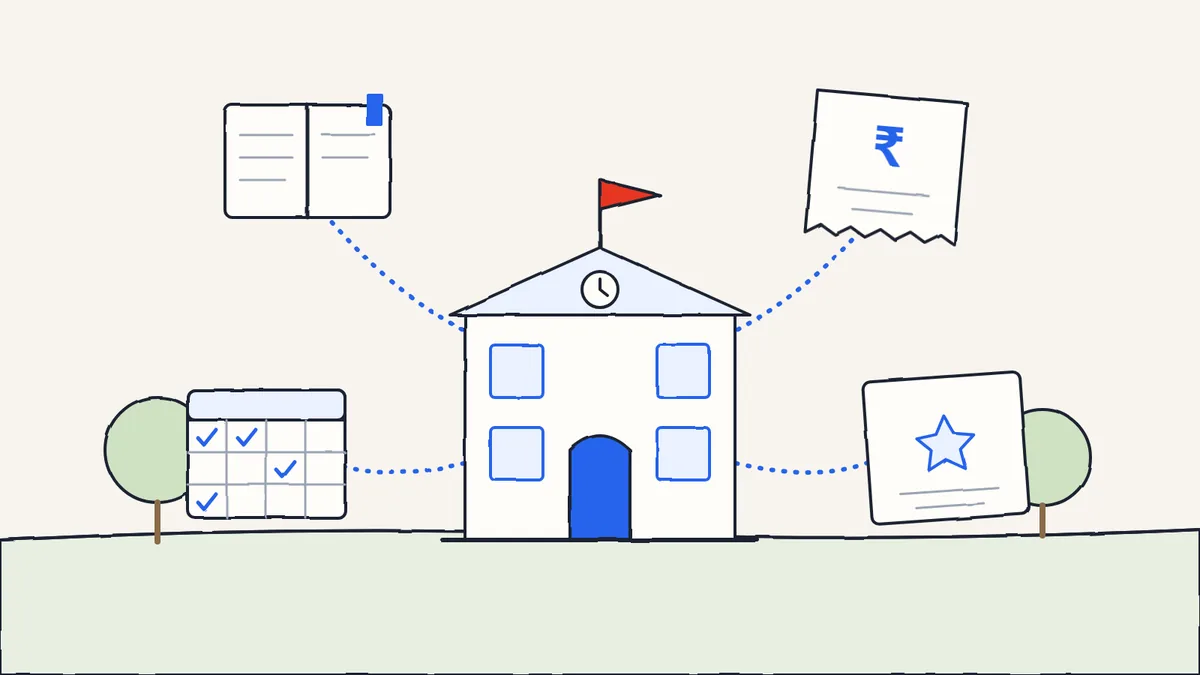
Education ERP is built around one rule: everything about a student is kept in one place. When a student is admitted, one student record is created. Class, fees, transport route, hostel bed, parent app login and report card are all set up from that one record.
It sounds obvious until you see the alternative: entering the same details six times, in six places, with three different spellings of the surname.
- Fees portal
- Attendance app
- Marks spreadsheet
- SMS account
- WhatsApp group
- Old library program
- One student record
- Class and timetable
- Fees
- Transport
- Hostel
- Parent app login
- Report card
What "admit once" does
Once the offer is accepted and the admission fee is paid, the work that would sit on someone's to-do list is already done:
- Student record created with a student IDThe same ID is used everywhere, so nothing is typed twice.
- Parent login readyThe family can use the parent app from day one, not after a week of follow-up.
- Fees set up for the yearTerm instalments and transport fees, all linked to the same student.
- Added to the class list, timetable and attendanceThe same morning, with no "we will add them tomorrow" gap.
- Transport route and hostel bed assignedWhere they apply, all against the one student ID.
None of this is magic. It is what happens when every department works from the same records instead of keeping its own copy.
The reports finally agree
The biggest change is not a new feature. It is a question you stop asking: "Which version of this number is right?" There is only one version. The principal's summary, the accountant's books and the fees portal all show the same figure. If a number is wrong, it is wrong in one place, and fixing it there fixes it everywhere.
That is not a sales claim. One copy of a figure cannot disagree with itself.
A record of every change
When every change to a student goes through one system, you get a history without extra work. "Why was this concession given?" shows who approved it and when.
With six tools, those answers are spread across six inboxes, three WhatsApp groups and someone's memory. By the time the board inspection comes, half of them are gone.
What this is not
This is not an argument for swapping tools you like for worse ones. If your online fee payments work well, you do not need to drop your payment provider. The question is whether your student records are linked to those payments or keep a separate copy of them. Education ERP works with Razorpay, PayU, Paytm and CCAvenue, and with UPI QR codes, for exactly this reason. The ERP's job is to be the one place the rest of the school trusts.
It does not matter which tool collects the fees. What matters is which system the school trusts to say who the student is.
When this matters most
The cost of six tools is easy to miss until a moment like one of these:
- A board inspection asks for three years of student transfer records.
- A trustee asks for "total fees due across all campuses" and gets three different numbers.
- A parent calls to ask why they received a reminder for fees already paid.
- A new principal asks for "the full picture" and finds it does not exist.
- Someone is asked to set up a parent app login for a student enrolled two months ago, and the app has no record of them.
Each of these is the moment the cost of scattered records comes due. The case for one set of records is not neatness. It is that you stop paying that cost.
What's new (October 2026)
- A new student app release. Parents with more than one child at the school switch between siblings in one app, and the app sends push notifications.
- Online fee payments are confirmed with the payment gateway, so the student's fee record and the gateway agree.
Send us a term-end paper. We will mark it free.
No commitment. We mark it with SkoraAI and email you the marked sheet, with the reason for every mark, the weak areas, and our price for a pilot. Your teacher checks every mark alongside ours.