Home
Products ๐Ÿค–
Skora AI AI Grading
โœจ
Teach Smart AI Co-teacher on your books
๐ŸŽ“
Education ERP School & college platform
๐Ÿ‘ฅ
HRMS & Payroll People ยท payroll ยท compliance
Partners Pricing Blog Demo Contact
Talk to sales Book a demo
Sub-feature ยท Teacher Review

AI grades. Teachers stay in control.

An override workflow built around a real classroom โ€” anomalies surface to the front of the queue, confident grades auto-publish, and every teacher decision is logged with the original AI verdict preserved.

Review workflow

Five stages from machine grade to teacher-signed score.

The AI grades, the system flags anything uncertain, the teacher decides โ€” and every step of that decision is preserved.

01

AI grade

Every answer is scored against the key with math equivalence, choice rules, and partial credit applied uniformly across the class.

02

Anomaly flag

Low OCR confidence, large variance from the class, or unusual choice patterns surface the submission to the review queue โ€” clean papers move on.

03

Teacher override

The teacher reviews the flagged answer, applies a one-tap override (or accepts the AI mark), and adds a short reason note for the audit log.

04

Final score

With teacher decisions applied, the per-question marks are finalised and rolled into the student's report โ€” capped at each question's maximum.

05

Audit trail

Original AI verdict, prompt version, OCR confidence, every override and reason note โ€” all preserved forever, queryable for later analysis.

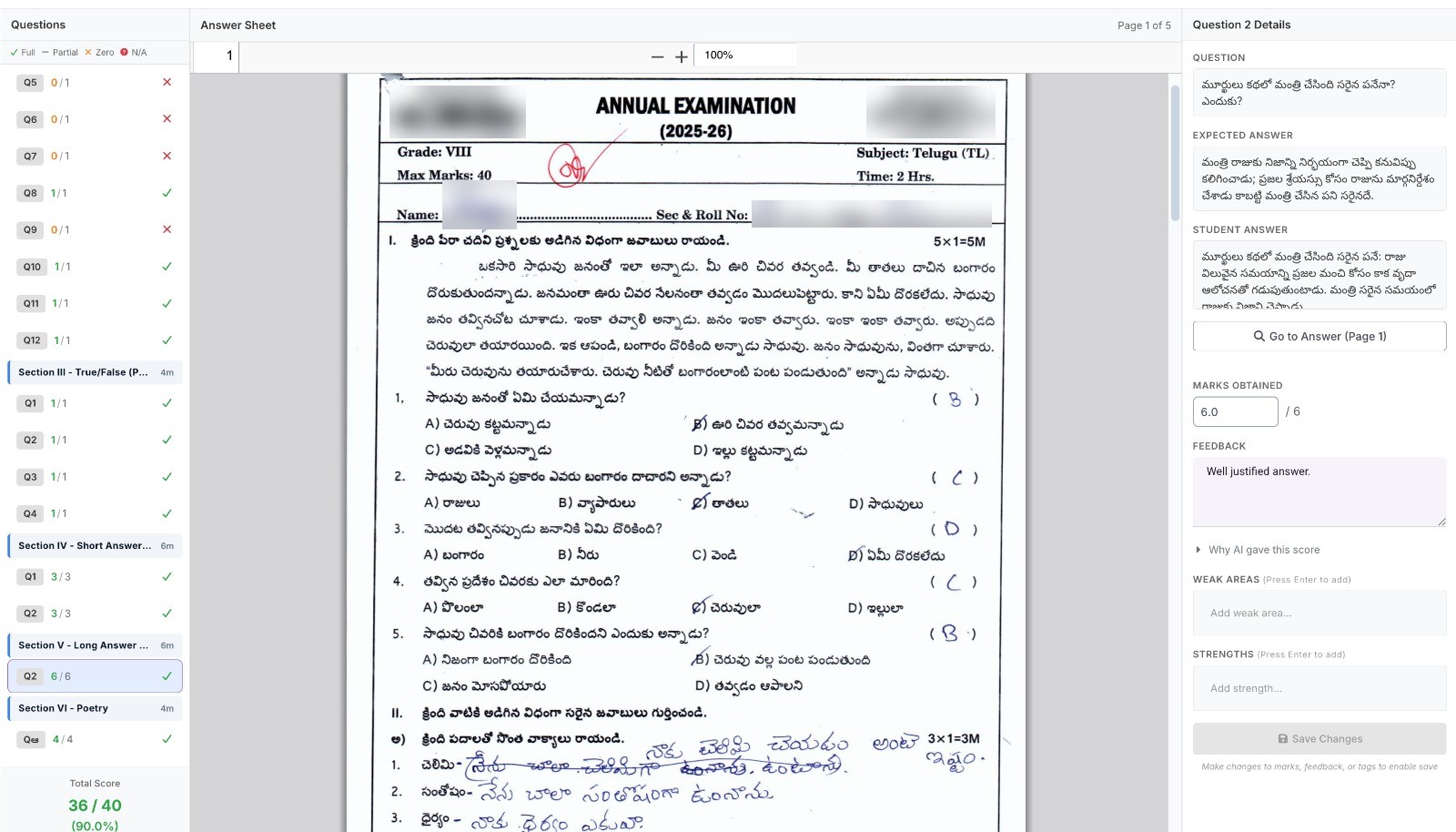
Override ยท Audit ยท AIReasonPoints

Override anything. Keep the original AI verdict.

When a teacher overrides AI marks, Digiclove preserves the original โ€” so you can later analyse where AI and teachers disagreed, and whether the AI is calibrating well over time.

  • One-click override on per-question marks, with reason note
  • Original AI marks & prompt version preserved on first override (forward-only)
  • Teacher action log per submission โ€” who changed what, when, why
  • Bulk apply override patterns across the same question for the whole class
Override panel showing original AI marks, teacher override, reason note, and AIReasonPoints audit trail
Class overview ยท Rankings ยท Subject averages

Every student, every subject, one screen.

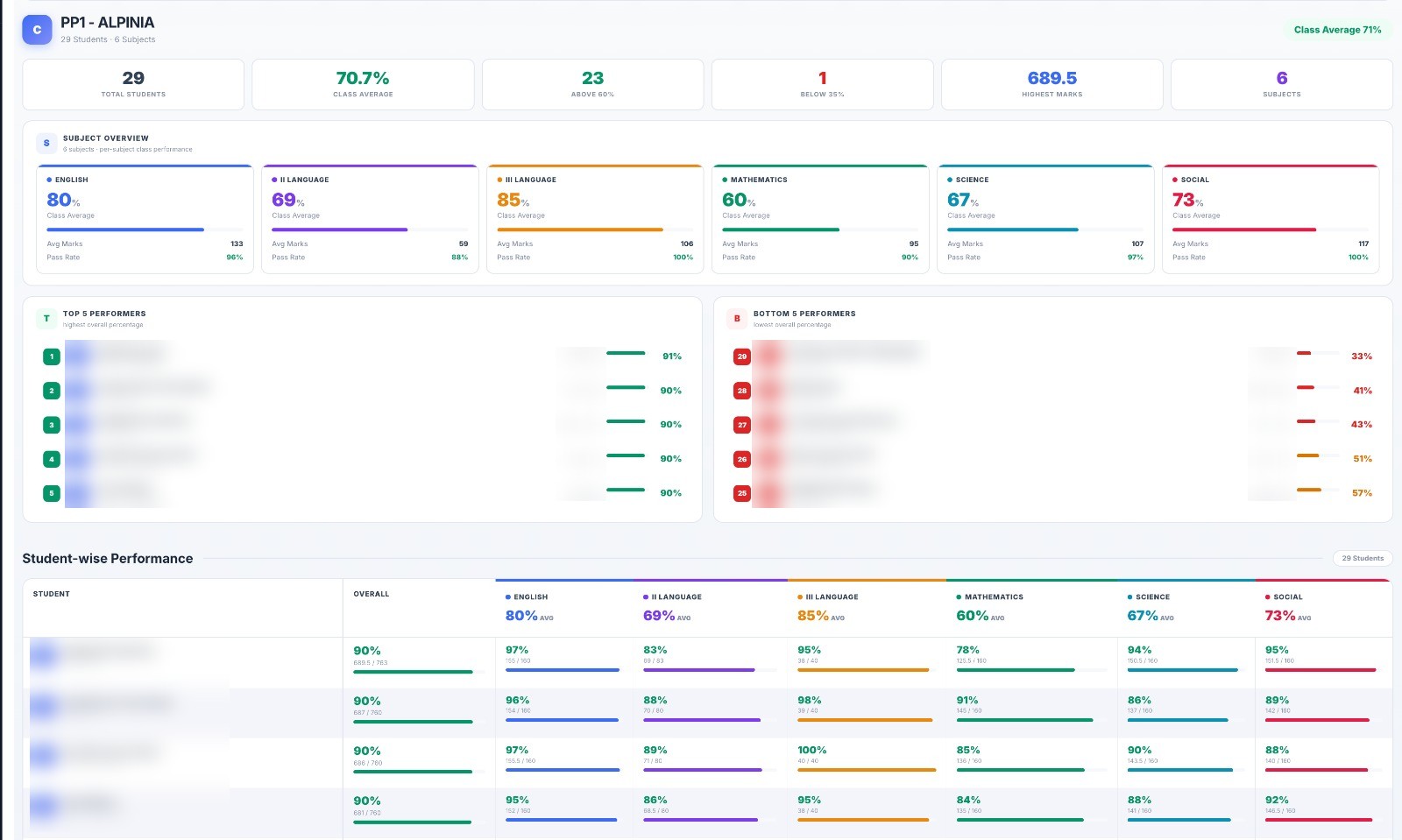
The Class Student Detail Report gives teachers an instant read on how the whole class performed โ€” ranked by overall percentage, with per-subject averages and top/bottom performer lists built in.

  • KPI strip: total students, class average, above 60%, below 35%, highest marks, subject count
  • Subject overview panel โ€” per-subject class average, pass rate, and teacher name at a glance
  • Top 5 and Bottom 5 performers ranked by overall percentage
  • Full student table with per-subject marks and colour-coded percentage badges โ€” click any student for a subject breakdown
  • Filter by location, class, section, and one or more exam types
Class Student Detail Report showing student rankings, subject averages, and KPI strip
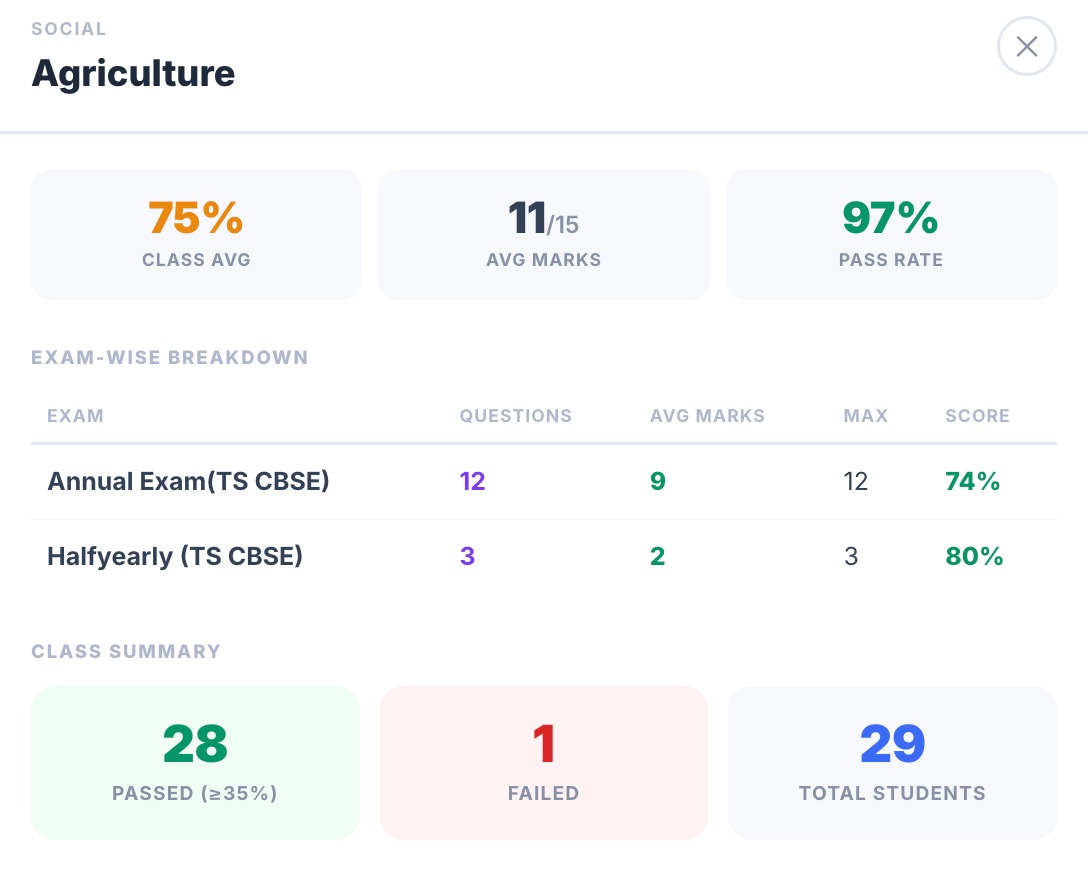
Subject drill-down showing class average, exam-wise breakdown table, and class summary with passed and failed counts
Subject drill-down ยท Exam-wise ยท Class summary

Click a subject. See every exam that touched it.

Drill into any subject from the class report and see the full picture โ€” class average, average marks, pass rate, and a per-exam breakdown showing exactly how many questions appeared, what the class averaged, and the score percentage for each exam in the term.

  • KPI tiles: class average %, average marks out of maximum, pass rate
  • Exam-wise breakdown table โ€” questions count, avg marks, max marks, and score % per exam
  • Class summary: passed (โ‰ฅ35%), failed, and total students in one view
  • Works across any number of exam types โ€” annual, halfyearly, unit tests โ€” in one panel
Outcomes

What happens after Teacher Review goes live.

82%
Of grades auto-approve. Teachers spend their time only on the flagged 18%.
25 min
Average time a teacher spends reviewing a class of 42 papers โ€” vs. ~6 hours of full grading.
100%
Audit coverage โ€” every override, every reason note, every prompt version logged.
Frequently asked

Teacher review questions teachers ask first.

Which submissions are auto-approved versus surfaced for review?
A submission auto-approves when grading confidence is high across every answer, OCR confidence is clean, and no anomaly flags fire โ€” low confidence on any answer, large variance from the class average, a large delta from the student's recent performance, or unusual choice-rule patterns (the student answered every "any 3 of 5" option). The default threshold is roughly an 80/20 split, configurable per paper.
When I override a mark, what gets recorded?
On the first override of any question, both the original AI marks and the prompt version that produced them are captured into a forward-only audit column on trGradingResult โ€” they're never overwritten by subsequent overrides. The teacher's reason note, timestamp, and user identity are also logged. This preserves a complete "AI said X, teacher said Y, here's why" trail for post-cycle review.
Can I apply the same override to the same question across the whole class?
Yes โ€” bulk apply lets you reuse an override pattern on a single question across every student in the class. Useful when a chapter ambiguity or an answer-key correction surfaces during review. Each affected submission still gets its own audit entry, and the bulk action is itself logged so the change set is reproducible.
What does the strictness setting actually change?
Strictness (L1 Very Lenient โ†’ L5 Very Strict) is a per-paper tie-breaker that only kicks in where the answer key is silent on a particular keypoint or judgment call. It never overrides explicit keypoints โ€” those are authoritative. In practice, Lenient awards more partial credit on paraphrased subjective answers; Strict requires precise terminology. The setting is visible to the reviewing teacher.
Will the AI learn from my overrides?
Not in the "fine-tune the model" sense โ€” tenant data never trains the underlying foundation models. Overrides do drive analytics that surface patterns: which question types or chapters the AI most often disagrees with teachers on, whether agreement is improving across prompt versions, and which answer-key sources (KeySheet vs RagChapter vs AiGenerated) account for most overrides. Those patterns inform prompt-engineering changes that ship versioned through GradingPromptVersion.

Run a parallel grading cycle. We'll compare.

Pick a paper your teachers already graded. We'll grade in parallel and show you exactly where AI agreed, where it didn't, and what teachers spent time on.

Run a parallel cycle Back to overview