Home
Products 🤖
Skora AI AI Grading
Teach Smart AI Co-teacher on your books
🎓
Education ERP School & college platform
👥
HRMS & Payroll People · payroll · compliance
Partners Pricing Blog Demo Contact
Talk to sales Book a demo
Skora AI · pipeline

Hand a scanned answer sheet. Get back marks, feedback, and a study plan.

Skora AI is built as a comprehensive evaluation workflow that manages every stage of the assessment process — from paper configuration and handwriting recognition to structured answer extraction, choice-rule validation, anomaly checks, and student-level learning insights.

Designed for real examination environments, real handwriting, and seamless teacher review.

✓ CBSE · ICSE · State boards · IB ✓ Math · Science · Languages ✓ MCQ · VSA · SA · LA · Match
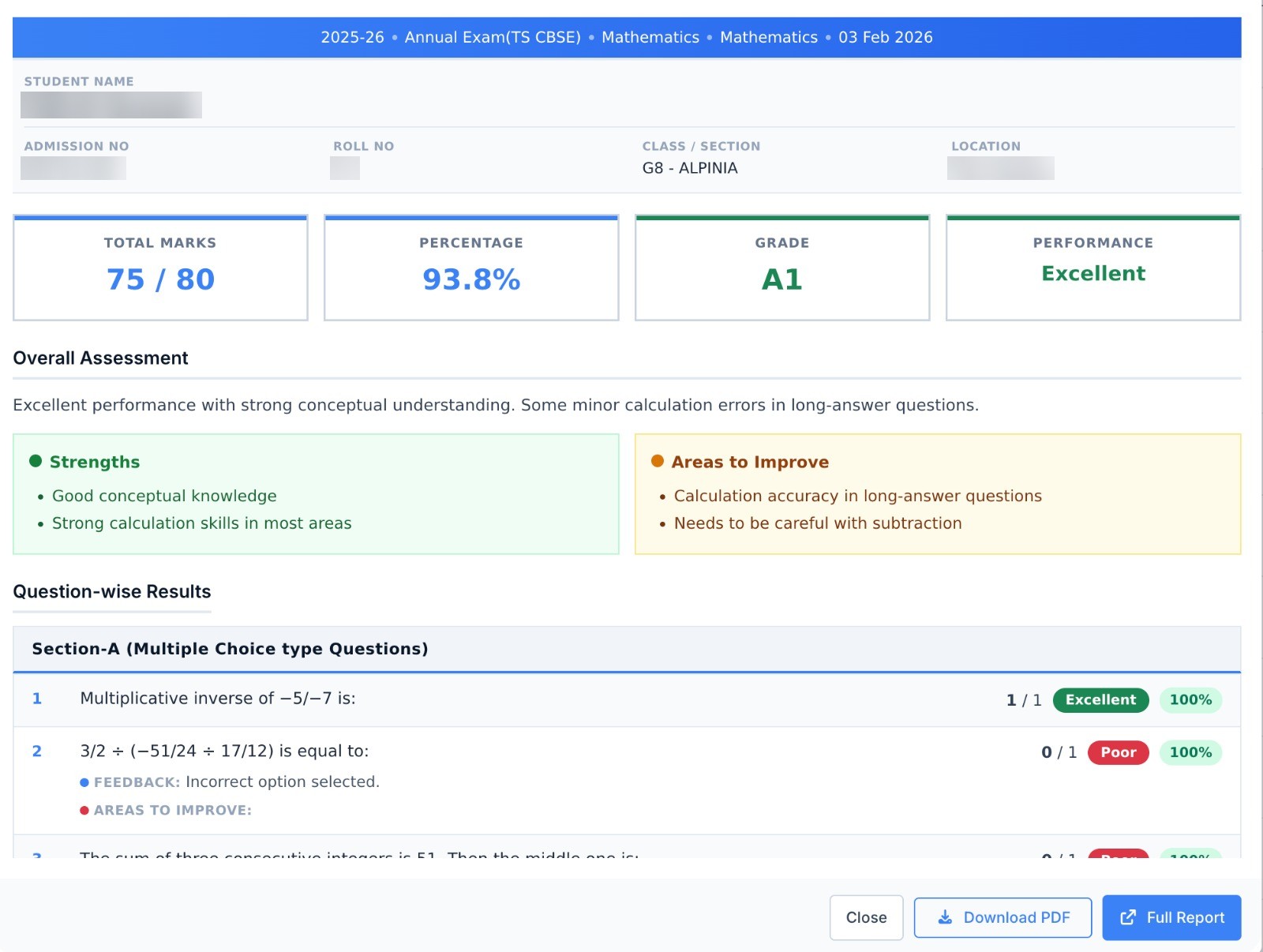
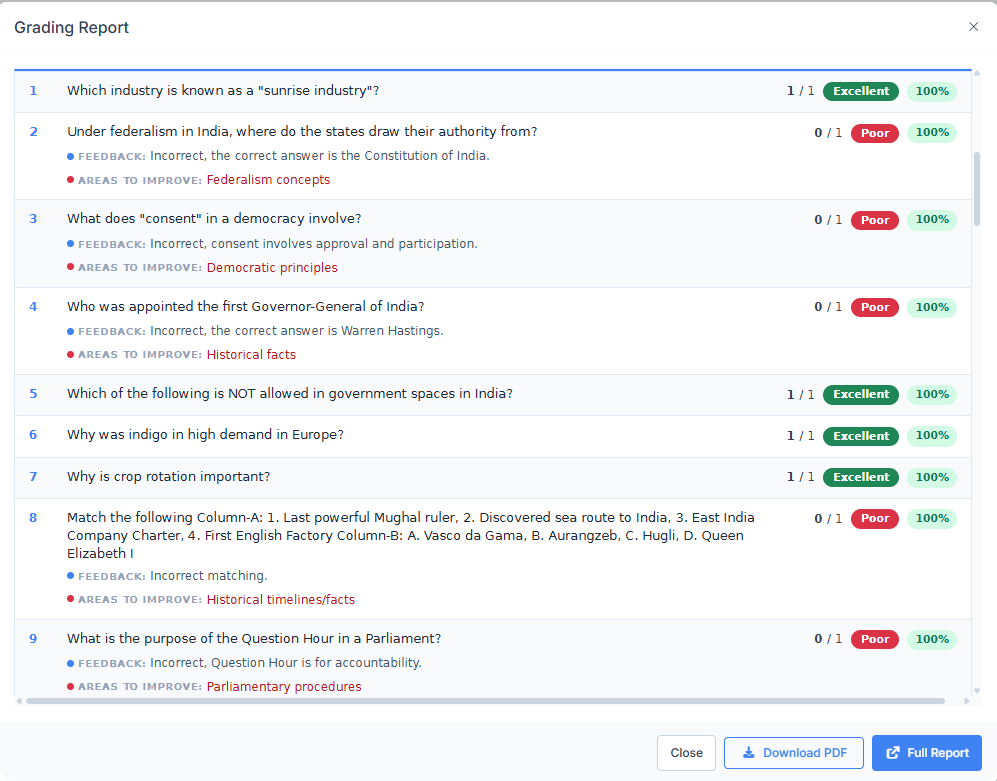
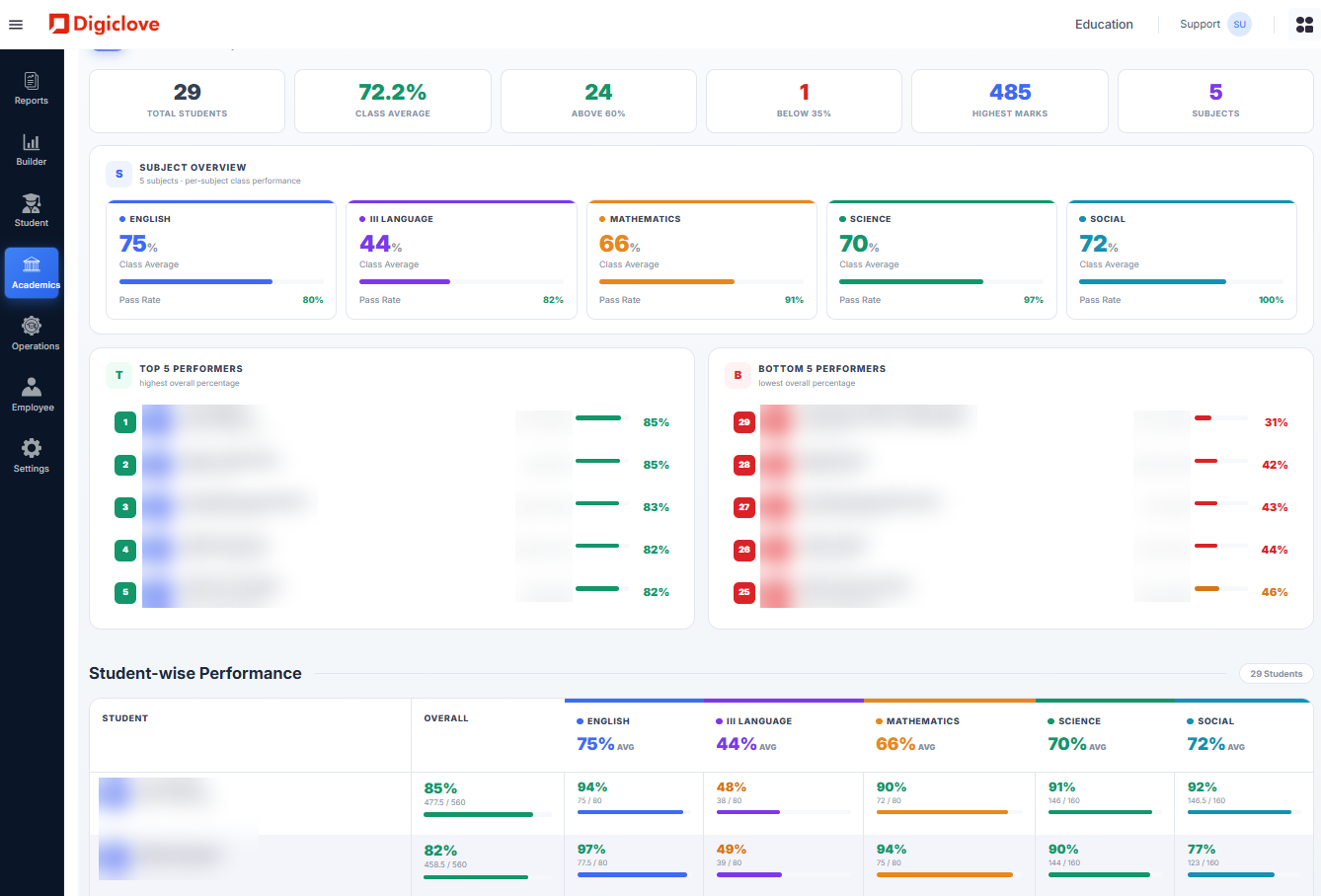
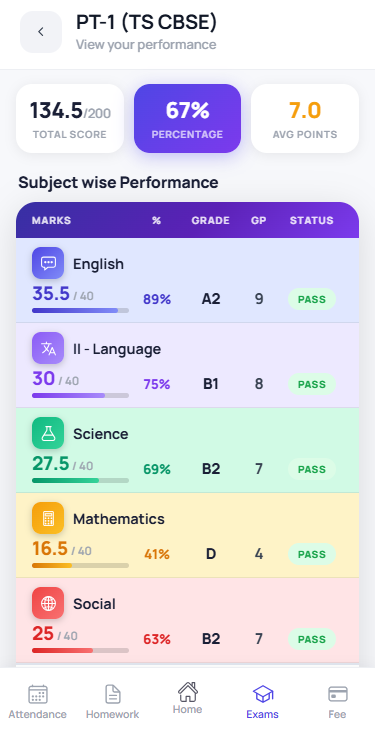
Skora AI student report showing per-question marks, score, and learning recommendation
What it does

From scanned answer sheets to actionable performance insights — Skora AI manages the complete evaluation workflow.

Our platform intelligently interprets question papers, processes handwritten student responses, evaluates answers with structured grading logic, and generates detailed feedback, analytics, and personalized study recommendations.

It’s not just automated grading. It’s an end-to-end academic evaluation ecosystem built for real-world assessments.

STEP 01
Scan answer sheets
Every question, mark, and handwritten answer read automatically
STEP 02
AI grades every answer
Matched against answer key question by question — including handwriting
82%
STEP 03
Performance insights
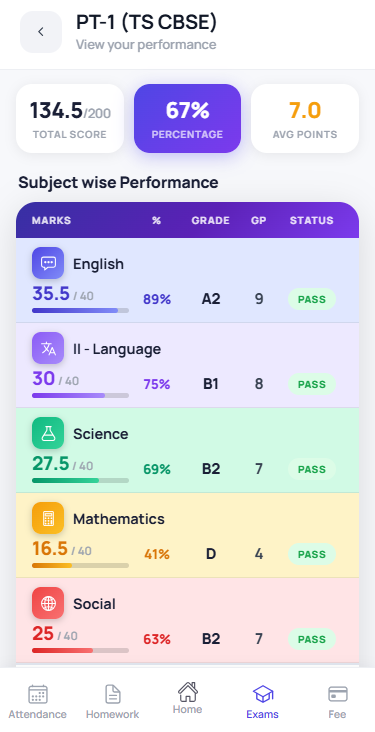
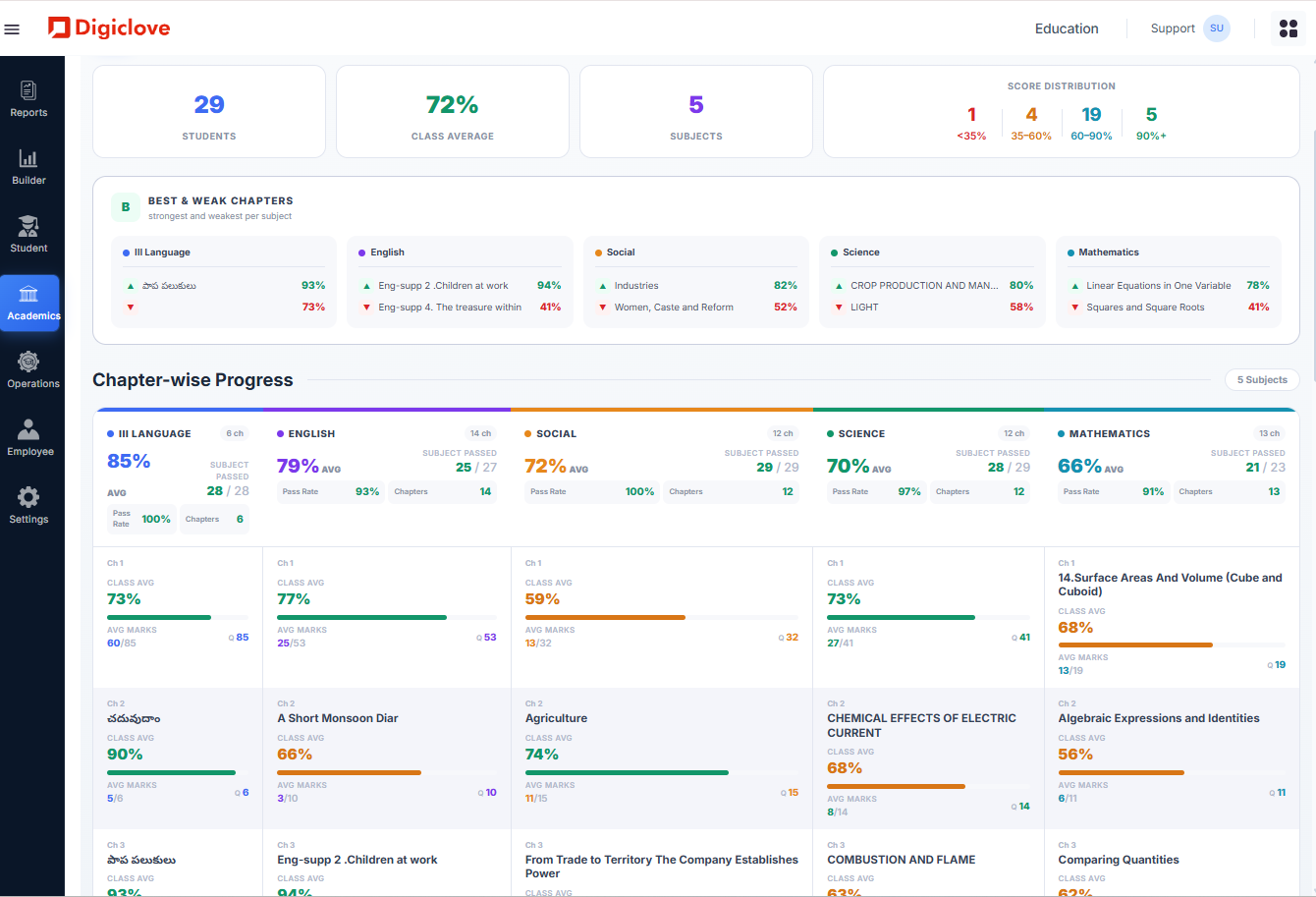
Scores, weak chapters, and study recommendations — instantly
01
Reads the question paper

Turns your question paper into structured questions, marks, and answer keys.

02
Grades every answer sheet

Marks each student's answers question by question against the paper.

03
Reads handwriting at scale

Reads scanned answer sheets — handwriting included — and matches each to a student.

04
Links to your syllabus

Ties feedback back to your own textbooks, so weak areas point to the right chapter.

05
Connects teaching content

Links graded results to relevant lesson material for fast follow-up.


STEP 1
Upload the paper

Drop in the question paper PDF and, if you have one, the answer key. That's it — the rest happens automatically.

STEP 2
Every page read for you

Skora AI reads both PDFs — sections, questions, options, tables, even handwritten formulas — without you having to type a single question.

STEP 3
Sections, questions, marks — mapped

The full exam blueprint appears in front of you: sections, questions, sub-questions, marks. If anything looks off, you'll see a flag before grading starts.

STEP 4
Answer key, ready to review

If you uploaded a key sheet, we use it. If not, the chapter content fills in the gaps. Every answer is tagged with where it came from — so teachers know exactly where to look.

STEP 5
Ready to grade

Your paper is locked in. Teachers can tweak any question or answer before the first student sheet arrives.

Paper preview
Bhashyam Educational · Class X
Science · Final Examination
80 / 80 marks ✓
Section A · Objective
Q1 · MCQ · "Which is a noble gas?" 1 mark · key sheet ✓
Q2 · Fill in the Blank 1 mark · key sheet ✓
Q3 · Short Answer 3 marks · from chapter
Section B · Long Answer
Q4 · Essay · 5-part 10 marks · key sheet ✓
Key sheet From chapter AI fallback
STEP 1
Scan the answer sheets

Bring sheets in any way that suits you — scanner, multifunction copier, even a phone camera. One sheet or several thousand at a time.

STEP 2
The student is identified automatically

Name, roll number, admission number — picked up from the header of the sheet. No spreadsheet matching, no manual sorting.

STEP 3
Every answer read and understood

Handwriting, math equations, diagrams, MCQ bubbles — extracted and lined up against the right question. Untouched questions are left blank, not guessed.

STEP 4
Graded against your answer key

Each response is judged against the key — with math equivalence, choice rules, and partial credit applied. The teacher's grading style (lenient, standard, or strict) is honoured at the paper level.

STEP 5
Choice and option rules respected

"Attempt any 3 of 5." "Either Q5(a) or Q5(b)." "Any 4 from Section B." All applied automatically — the student's best-scoring answers count.

STEP 6
Anomalies surface for the teacher

Anything unusual — low confidence, an outlier mark, an unexpected answer — is flagged for review. Clean papers move through; the rest land in a queue.

STEP 7
Next-step revision, ready

Weak topics are linked back to the exact textbook page, formula, or diagram that covers them — so the student gets a revision path, not just a mark.

Upload hundreds of answer sheets at once. Each one is matched to the right student in your class list using the header — name, roll number, admission number. You're only asked to step in when we're not sure.

Confident match

The sheet lines up cleanly with a student — grading starts on the teacher's go-ahead.

Needs a quick look

Close match but not certain. Surfaced in a review screen — teacher confirms or corrects in one click.

Needs your help

No match found — teacher assigns it to a student manually, or marks it as missing.

Connect your textbooks, workbooks, and additional materials once per chapter. Skora AI uses them to write more accurate answer keys, mark long answers fairly, and recommend personalised revision to every student.

Textbook

The primary source for every chapter. Defines what's "correct" for that classroom.

Workbook

Practice problems and exemplars. Optional — add it if your school uses one.

Additional materials

Slide decks, notes, references — anything else the teacher considers part of the syllabus.

Connected once. Used everywhere — answer keys, grading, revision recommendations, Textbook Chat.

Cost at scale

Grade 10,000 papers for less than the cost of one TA day.

A structured pipeline with prompt and structure caching keeps per-paper cost flat as volume grows — so a single department can run an exam cycle on a budget that wouldn't pay for a teaching assistant for a day.

Under the hood

Production safeguards, not a demo.

Regression guard on PaperSetup re-runs
When a paper is re-run, the new structure is compared to the existing one. If the new extraction has fewer answer keys or the question count changed by more than 20%, the old structure is kept — preventing AI degradation from a model update or transient parser glitch.
MTF (Match-the-Following) auto-sanitization
After answer key extraction, the validator automatically fixes Match-the-Following questions with missing keyPoints, malformed pairs, or incomplete key structures. No teacher intervention needed for the common error modes.
Mathematical equivalence checking
Algebraic (x²+2x+1 = (x+1)²), numeric (0.5 = 1/2 = 50%), unit (100cm = 1m), commutative (a+b = b+a), simplified vs unsimplified (2/4 = 1/2), scientific notation, trigonometric identities, balanced chemical equations, vector forms, log/exp, set notation. When in doubt, marks are awarded.
Five-level grading strictness
L1 Very Lenient — generous partial credit, paraphrased answers accepted. L2 Lenient — reasonable partial credit. L3 Moderate — balanced (default). L4 Strict — precise answers required. L5 Very Strict — textbook-level precision.
Answer key source tracking
Every answer key is tagged: KeySheet (from teacher's PDF — highest confidence), RagChapter (generated from chapter content), AiGenerated / AiGeneral (AI-generated fallback). Pill badges in the editor show teachers exactly where to scrutinise.
Anomaly detection & teacher review
Submissions are auto-approved when grading confidence is high and no anomalies are detected. Otherwise they're flagged with a reason — low confidence, high variance from class average, large delta vs prior performance — and surface in the review queue.
Per-paper cost telemetry
Every AI call is logged with provider, model, tokens, cache hits, duration, and cost. The vPaperSetupTelemetry view pivots costs by stage (layout, structure, answer key, cascade) so you find expensive papers and track structure-retry frequency by syllabus or board.
Frequently asked

Skora AI questions principals and teachers ask first.

How accurate is the grading compared to a human teacher?
For objective question types (MCQ, True/False, Fill-in-the-Blank, Match-the-Following, One-Word) Skora AI grades deterministically from the extracted answer key — agreement with the teacher is effectively 100% once the key is approved. For subjective answers (SA / LA / Essay / Numerical), teacher-AI agreement on production papers sits in the high 80s to mid-90s depending on subject and strictness setting. Every disagreement is preserved via the OriginalAiMarks audit column, so accuracy is measurable per paper, per cohort, per term.
What happens when the AI is unsure — does it just guess?
No. Submissions with low grading confidence, low OCR confidence, outlier marks vs class average, large deltas vs the student's history, or choice-rule complications are flagged and surfaced into the teacher review queue with a specific reason. Clean papers auto-approve. The default 80/20 split is configurable per paper.
How are answer keys built — and how trustworthy are they?
Each answer key is tagged with its source: KeySheet (extracted from a teacher-supplied key PDF — highest confidence), RagChapter (derived from the indexed chapter content — high confidence), AiGenerated or AiGeneral (LLM fallback — lowest confidence, flagged for review). Pill badges in the editor show teachers exactly which keys to scrutinise. A regression guard refuses to overwrite an existing key when a re-extraction loses more than 20% of the questions.
Can teachers override grades, and is the original AI verdict kept?
Yes — every per-question mark is one click to override, with a reason note. On the first override, both the original AI marks and the prompt version that produced them are captured into a forward-only audit column (OriginalAiMarks / OriginalAiPromptVer). This means you can run "AI vs teacher" analyses over time and see whether AI calibration is drifting after a prompt or model update.
What about choice rules — "attempt any 3 of 5", internal OR, section choices?
Honoured automatically. Skora AI extracts the choice structure during paper setup, and at grading time selects the student's best-scoring subset for each rule. "Attempt any 3 of 5", "Either Q5(a) or Q5(b)", "Any 4 from Section B" — all applied so the student's mark is the maximum achievable under the rule, not penalised for over-attempting.

Send us a paper. We'll grade it for free.

Pick any term-end paper. We'll run it through the pipeline and show you per-student reports — at no cost, no commitment.

Send a paper Request a quote