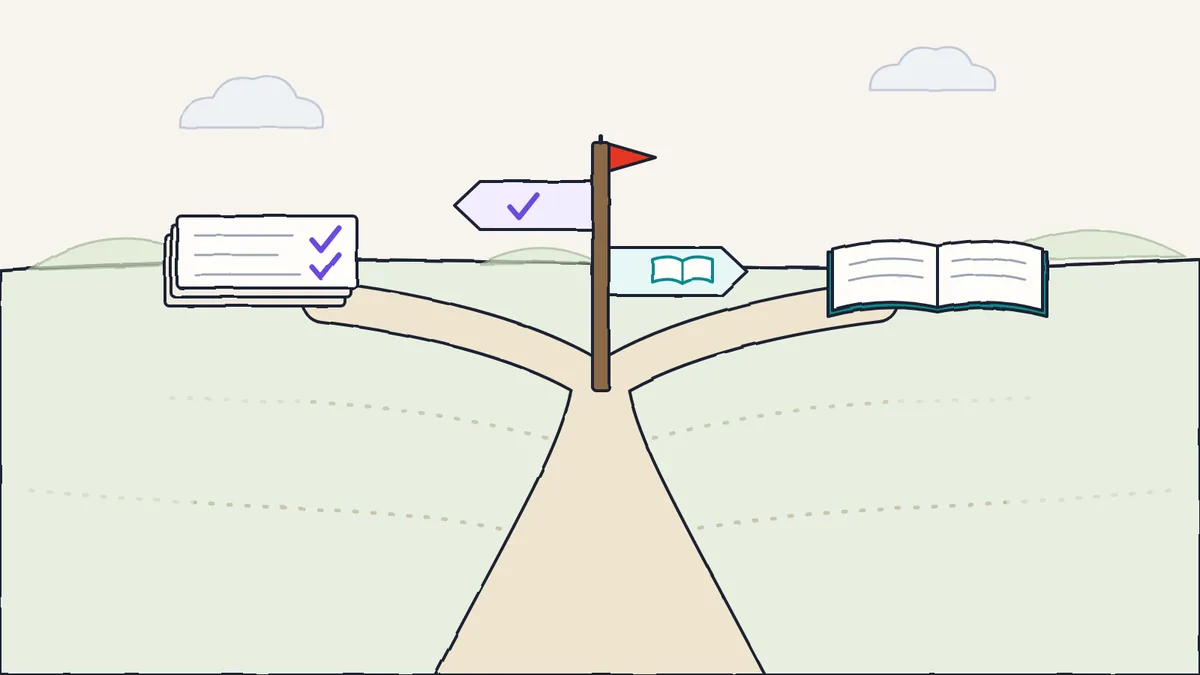
If you have heard a sales pitch about AI in education recently, you have probably heard about personalised learning paths, AI tutors, predicting student outcomes and more. Most of these are not in real use anywhere, or are in use somewhere and quietly not working.
Setting the optimism aside, only two uses of AI have become part of daily school life. This post looks plainly at what they are, why they work, and why the others have not caught up yet.
- AI markingA teacher approves every mark
- Teaching material from your booksThe teacher edits it before class
- AI tutorsTalk to students with no teacher watching
- Personalised learning pathsCannot be spot-checked
- Predicting who will fall behindPromises more than school records can show
The two that work, and why
1. AI marking
The biggest win is marking. It works because the job has clear inputs (the answer sheet and the answer key), a clear result (marks for each question with reasons), and, most importantly, a teacher who approves the result. The teacher's ability to change any mark is the safety net that lets a school use AI without risking its whole mark register.
It also works because every mark can be checked. Each one shows which points of the key the student covered and which they missed, so a teacher can check any decision quickly. What is automated is the repetitive part of marking, comparing the answer to the key, not the judgement. AI is also kept to the answers that need it: in SkoraAI, multiple-choice and one-word answers are scored by fixed rules from the key, never by the AI.
2. Teaching material made from the school's own books
The second is teaching material: quizzes, worksheets, lesson plans, slide decks and reading passages, all the material a teacher rewrites every term. But it only works when the material is made from the school's own textbooks, not from general knowledge off the internet.
General AI tools fail the second-week test: the teacher spends as long fixing the output as writing it. Material made from the school's books passes, because the level and the vocabulary already match the book on the student's desk. In TeachSmartAI that now covers 17 kinds of material, from lesson plans and worksheets to flashcards, mind maps and flow charts, with a full-screen Present mode for the classroom projector.
Why these two, and not the others (yet)
Both share three things that the others lack:
| Quality | Works in classrooms | Doesn't work yet |
|---|---|---|
| Easy to check | ✓ Teacher checks a mark or worksheet straight away | ✕ A "personalised learning path" can't be spot-checked |
| Teacher approves by default | ✓ No mark or worksheet goes out without approval | ✕ An AI tutor talks to students unsupervised |
| Mistakes are easy to fix | ✓ Change a mark; edit a question | ✕ Bad advice builds up for a month unnoticed |
AI works in schools when it writes the draft and the teacher decides the final version. It doesn't work when it makes decisions about students that nobody checks.
What about AI tutors?
This is the most talked-about idea and the one that does least well in practice. The reasons are simple. A tutor works one-to-one with a student, often unsupervised and out of the teacher's sight. The same made-up-answer problem that makes general chatbots risky in any classroom gets worse: a wrong answer goes straight into the student's understanding, with no teacher to catch it.
The nearest thing that does work is Textbook Chat: questions and answers that come only from the school's own books. From outside it looks like a tutor. It works differently: it can say "I don't know", every answer can be checked against the book, and the teacher can use it with a class without worry.
What about predicting student outcomes?
The realistic version, "students who score low on certain questions in Term 1 usually need extra help by Term 2", is real and useful. But it is ordinary analysis of good records, not clever AI. The ambitious version, "we can predict which student will fall behind before it happens", promises more than it delivers, because school data is messier than the sales pitch suggests.
What actually helps is showing teachers what is happening now, clearly. Most schools have not yet made full use of that. There is no need to leap ahead.
Useful AI in schools looks ordinary
Look past the demos and the conference talks, and the AI working in classrooms today looks quite ordinary: a teacher reviewing AI marks, a teacher editing an AI worksheet, a student reading a chatbot answer taken from their own textbook.
It is not magic. The AI does the repetitive first draft, and the teacher makes the judgement. That partnership is what lasts beyond the second week. Most of the rest still doesn't.
Send us a term-end paper. We will mark it free.
No commitment. We mark it with SkoraAI and email you the marked sheet, with the reason for every mark, the weak areas, and our price for a pilot. Your teacher checks every mark alongside ours.