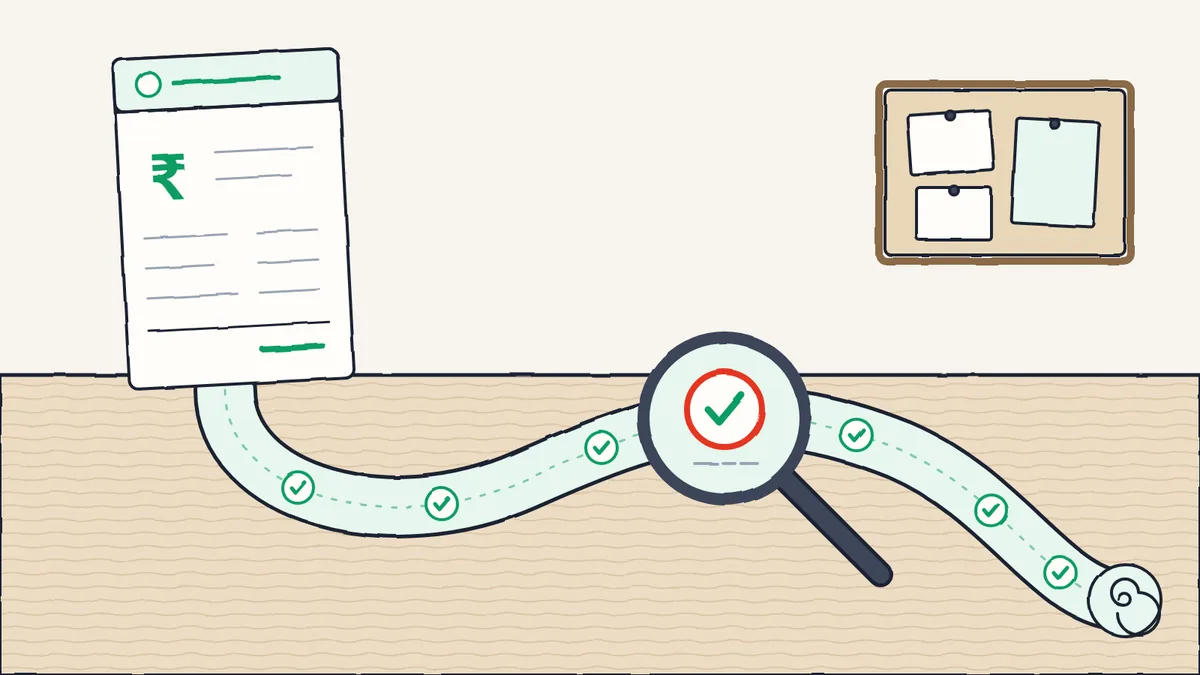
The hard questions in payroll don’t come on payroll day. They come three months later, in an email from an employee or a call from an auditor: “Mr. Iyer’s PF in June was lower than in May. Can you tell us why?”
If your honest answer is “let me check with whoever ran payroll that month”, you don’t have a payroll system. You have a payslip printer and a person beside it. A real payroll system can rebuild any payslip, for any month, from the original inputs, and explain every step in between.
Calculated Gross pay ₹84,200 PF ₹4,116 12% of PF wages PT ₹200 Karnataka rate TDS ₹6,840 new regime, declarations final Net pay ₹73,044
Approved by HR Head · 02-Apr-2026 09:14 Recalculated Same result from the same inputs
The four questions a payroll audit trail must answer
1. What were the inputs that month?
Attendance days, approved leave, approved overtime, approved adjustments, approved claims and advances. The audit trail starts here. If any of these sit in a spreadsheet that is overwritten next month, the trail is already broken.
In a good payroll system, each input has a source, a date and an approver. Attendance: from the biometric devices on the 31st, 21 working days, signed off by HR. Leave: 2 days CL and 1 day LOP, approved by the line manager on the 14th. Overtime: 6 hours, approved by the department head on the 27th. You cannot rebuild any of this from a payslip. It has to be recorded as the month happens.
2. What was the salary structure at the time?
Salary structures change. An employee gets an increment in March. HRA changes in April after a move to another city. Variable pay moves from quarterly to monthly. A weak system overwrites the old structure. A good one keeps every version, so May’s payroll uses the structure as it stood on 31 May, not as it stands today. Payroll rules can differ from branch to branch too, and in Digiclove they are set for each branch.
The most common reason a past payslip cannot be rebuilt is that the structure behind it no longer exists. Someone edited it last week.
3. What were the monthly adjustments, and why?
Arrears, bonuses, ex-gratia and deductions. These one-off entries make a month’s salary different from any other, and they cause most disputes. The record must show not only the adjustment but who entered it, who approved it and why.
“₹4,500 arrear, entered by HR on 10 March, approved by the CFO on 11 March, reason: January increment due from 1 January” is a useful record. “₹4,500 arrear” is not.
- Change enteredAn arrear, a bonus or a new salary structure
- Who, when and whyRecorded with the change
- ApprovedBy the right person, before payroll runs
- Earlier version keptThe old value stays on record
- Any month rebuiltSame inputs, same number
4. How was the final figure worked out?
The payslip shows the final number. The audit trail shows everything that produced it: each salary component, each statutory deduction with the rate applied, and the tax working showing the regime and the deductions claimed. None of this is unusual. It is just the arithmetic, kept together with its inputs.
If you cannot answer a question about a payslip without running the calculation again, the system is not doing its job.
The audit trail also catches mistakes before payday
An audit trail is not only for looking back. The same records that let you rebuild a payslip later also help you spot a wrong one before it goes out. The way to do it is a comparison with last month.
Compare each employee’s net pay this month with last month. Anyone whose pay moved by more than a set amount, often about 10%, is looked at before approval. The reviewer gets a short list of cases to explain, not 142 lines to scan by eye.
Almost every change has a simple reason: a bonus, loss of pay, a new salary structure, or a new joiner with a part month. But the rare case without a clear reason is exactly the one that would otherwise reach the bank file and turn into a refund and an apology two weeks later.
What else a full audit trail gives you
Once every step of every payroll is kept, other benefits follow:
- Calm inspections. A PF or ESI inspection is no longer a panic. Every contribution, deduction and challan can be traced back to the payroll that produced it.
- Simple final settlements. A leaving employee’s settlement (leave encashment, gratuity, notice recovery, last part-month) can be rebuilt in full, with the history behind every figure.
- Trust from staff. When employees know they can ask “why was June different?” and get a one-page answer, the quiet suspicion that payroll is “a bit off” goes away.
- Easier side-by-side runs when you switch systems. Moving from your old payroll? Run both for a month and compare line by line. Every difference can be explained, because both runs are fully recorded.
The standard to aim for
“We keep records” is not enough on its own. The standard is:
- Pick any past month and any employeeYou should see things as they were then, not only as they are today.
- Recalculate that payroll from the inputs as they stoodSalary structure, attendance, leave and adjustments, all as they were at that month-end.
- Get the same number, to the rupeeIf the answer changes, the system is applying today’s structures to past inputs. That is the problem to remove.
If your current system passes that test, you don’t need a new payroll system. If it doesn’t, it is worth fixing before the next inspection.
What’s new (October 2026)
- One set of attendance rules. Flexible-shift and loss-of-pay rules now apply the same way everywhere in payroll, so the same attendance always gives the same loss of pay.
- Safer sign-in. Sign-in sessions are safer, which matters when every change is recorded against the person who made it.
Send us a term-end paper. We will mark it free.
No commitment. We mark it with SkoraAI and email you the marked sheet, with the reason for every mark, the weak areas, and our price for a pilot. Your teacher checks every mark alongside ours.