Myth #1 — "AI grading just gives a mark."
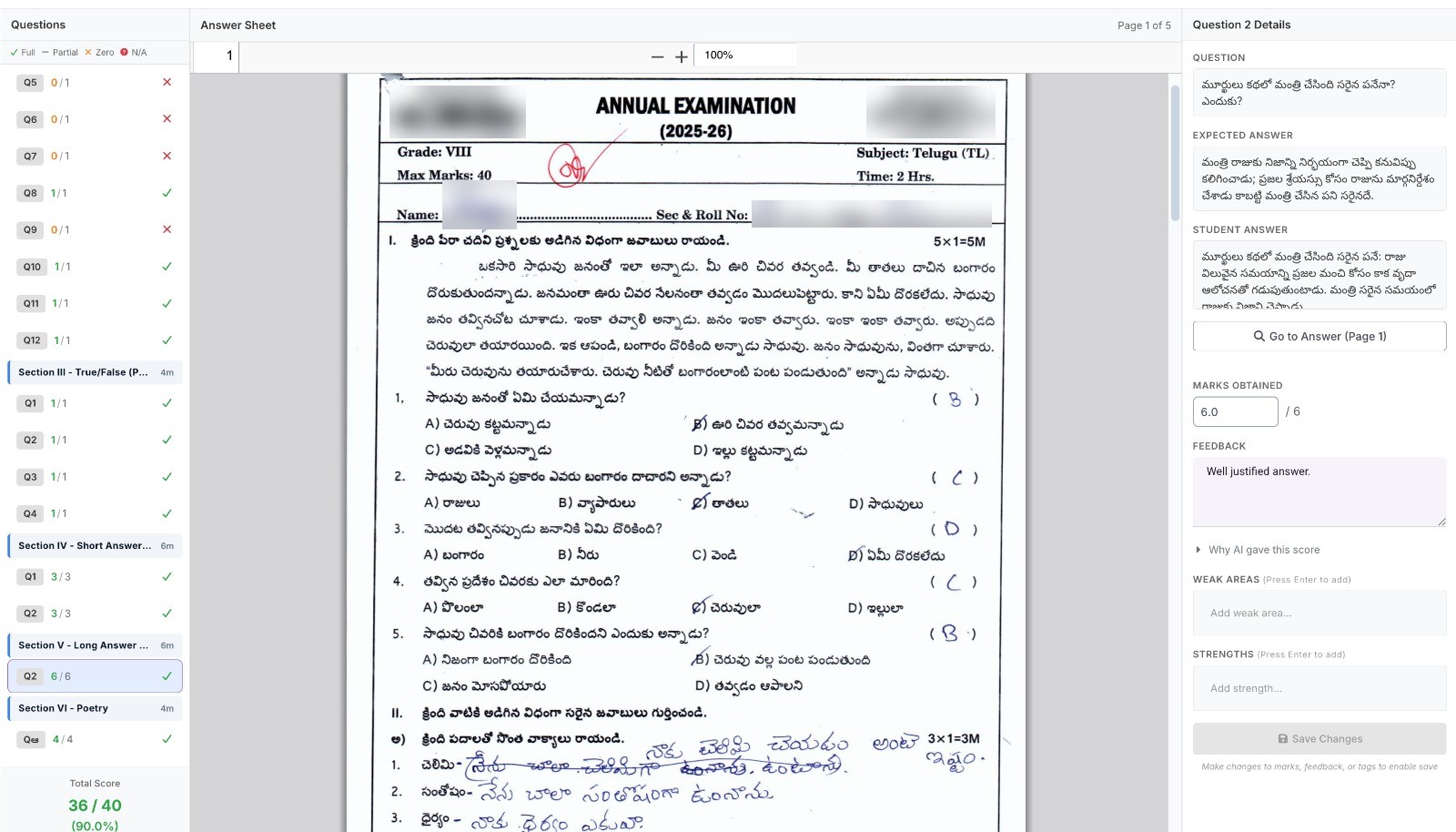
This one is the easiest to answer. A useful AI marker does not just return a number. For every question it shows which points in the key the student covered, which they missed, and whether a teacher changed the mark. Without that record, a mark cannot be checked, and a mark that cannot be checked is not worth much.
- The markFor each question, from your answer key
- Points coveredWhat the answer got right
- Points missedWhat the answer left out
- The reasonWhy SkoraAI gave that mark
- Teacher change keptSaved next to SkoraAI's original mark
SkoraAI keeps everything that makes a mark defensible: the marks, the points covered and missed, SkoraAI's original mark, and any teacher changes. This record is not for the student. It is for the teacher reviewing the paper, the principal checking the system, and for us when we look back months later. The record is also steady: marking the same sheet again gives the same marks.
Myth #2 — "Teachers won't accept it."
Teachers accept AI marking on one condition: they can change any mark easily, and the change is saved. The teachers who reject AI marking are rejecting marking they cannot see into.
If a teacher can change any question's mark with one tap and see exactly which points were covered, AI marking stops feeling like a machine and starts feeling like a careful assistant who has done a first pass.
In practice, most teacher changes are small adjustments rather than full rejections, and teachers check the flagged answers first. That is the gain, and it looks different for each of the three groups who handle a marked paper:
Points covered and missed for every question. The feedback is specific, not "could do better".
Checking SkoraAI's marks next to the sheet replaces marking every paper from scratch. The judgement still belongs to the teacher.
Weak areas by class and chapter before results are signed off, not after the term-end review meeting.
Myth #3 — "It can't handle handwriting."
Handwriting is real, and it is the hardest part. But "can't handle" is too strong. SkoraAI was built around the messy reality of school answer sheets, and when it struggles it does not quietly get it wrong. It flags the answer for review.
When an answer is hard to read, it goes to the teacher with the page of the original sheet ready to view. SkoraAI errs on the side of caution: better to ask the teacher than to guess. The same applies when the AI service itself has a brief outage: the sheet is retried or held, and a student is never given a zero because of it.
Myth #4 — "All AI grading tools are the same."
The simple approach is to hand the whole paper to an AI tool and ask for marks. That works for multiple-choice questions, but struggles with long answers, internal choices, either/or sections, and match-the-following questions with shuffled columns.
We have spent a long time making SkoraAI handle these real exam patterns. Multiple-choice and one-word answers are scored by fixed rules from the key, never by the AI, including option letters written in Telugu or Hindi and forms like "(B)" or "[B]". Each answer in the key shows where it came from. Choices are applied the same way for every student.
If a vendor cannot clearly explain how they handle a rule like "attempt any 4 out of 5", they are probably not built for real board-style exams.
Myth #5 — "It's too expensive at scale."
That may have been true earlier. It is not the case with SkoraAI.
We have worked hard to keep the cost per paper low while keeping marking accurate and consistent as volumes grow.
That makes AI marking practical for a whole school, not just a trial class.
What AI grading actually changes
The honest answer is term-end timing. Results that used to take weeks are ready as soon as teachers approve them. Teachers spend their time reviewing flagged answers instead of working through a marking pile. Principals see weak areas once marking is done, not after results are signed off.
These myths matter because the obstacle to AI marking is not the technology. It is the assumptions. If a principal believes any of these five myths, the conversation never reaches "how do we try it with one class".
What's new (October 2026)
- Fewer review flags. Answers are flagged only where a teacher really needs to look, so the review list is shorter.
- No marks for copying out the question. Marks come only from what the answer adds.
- Map questions marked by placement. SkoraAI checks where the student placed the mark on the map, not just whether the place is named.
- Re-mark one question across all sheets. When a teacher corrects the key for one question, only that question is re-marked on every sheet.
Send us a term-end paper. We will mark it free.
No commitment. We mark it with SkoraAI and email you the marked sheet, with the reason for every mark, the weak areas, and our price for a pilot. Your teacher checks every mark alongside ours.